Sunday, September 30, 2012

Enquirer's Urgent Plea: "Pull the plug" on "Train to Nowhere"

It's almost like COASTers woke up in a parallel universe the last few months.

After five years of our City leaders dreaming, planning, prevaricating, deficit spending and taxing, the Enquirer has just in the past 60 days repeatedly come out in full-throttled opposition to the foolish Streetcar project.  Until then they have been silent about the biggest public capital project in this City since the National Underground Railroad Freedom Center.

One day before losing the "conscience of the community" behind a firewall, the gray lady (the paper, not Mrs. Buchanan) has this bold clarion call to stop the insanity.

The highlights:
It’s time to pull the plug on the streetcar....
But it’s become clear there’s no sound plan to finance it. It’s a patchwork being stitched together a piece at a time. The pieces are now starting to come from other obligations, areas that are more urgent and would benefit more people....
The sale of the airport will bring $37 million to the city. That money is a windfall to a city that is falling behind on street and bridge maintenance and has other pressing capital needs, such as parks and police stations....

Those kinds of growth projections might seem optimistic in the best of times. These days, it’s almost cavalier....

We need to get off this train to nowhere.
It's almost like these words might have come off of COAST's keyboard.

Music to our frugal ears.

We might remind Enquirer readers and Cincinnati taxpayers that Mayor Mallory and his merry band of thieves have already spent more than $20 million to date on planning the streetcar, buying the bus barn, and sundry and assorted bells and whistles before the actual streetcars and tracks are purchased.  $20 million already down the pisser.

[As if COAST did not need yet another reason to oppose Cincinnati's Issue 4, the proposal to extend Council terms between elections (we call those accountability sessions).]

In any event, as we have said before, "welcome to the Party."


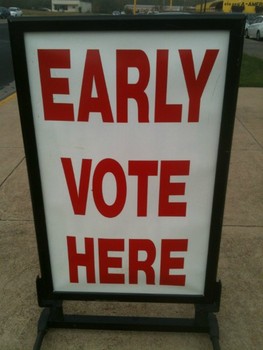
Early Voting Has Never Been Easier – Why let the Democrats Have All the Fun?


Early Voting begins Tuesday, October 2.

Democrat Groups and the Obama Turnout Machine are planning to vote early and lock in their votes. What do the Democrats know about early voting that Conservatives have forgotten?

Remove the risk of inclement weather or unforeseen circumstances. Request an absentee ballot or vote early in person and make sure your vote counts!
  
Early and absentee voting can be the key to this year’s election.

And, perhaps best of all, once your ballot is turned in, THE PHONE CALLS STOP, THE MAILERS STOP, THE KNOCKS ON YOUR DOOR STOP!

Every night, the parties and leading issue groups get updates from the local boards of election on who has turned in their ballot. Once your ballot is in, these groups know not to waste their time and money calling you because you've already voted!

Make your vote count, stop the phone calls and mailers: VOTE EARLY!

Early Voting can be done by mail or in person at your County's Board of Election Headquarters.  Below are links to your local board of election and the forms necessary to check your registration, register, vote early, request an absentee ballot and update your registration.  This year is a redistricting year, so use the links below to verify which Congressional and State Rep. District you're in.
  
Adams County: 2nd Congressional District (Wenstrup)
(937) 544-2633


Brown County: 2nd Congressional District (Wenstrup)
(937) 378-3008


Clermont County: 2nd Congressional District (Wenstrup)
(513) 732-7275


Hamilton County: - Split between 1st and 2nd District - Check for Changes! (Chabot and Wenstrup)
(513) 632-7000


Highland County: - Newly added to 2nd District (Wenstrup)
(937) 393-9961


Pike County: 2nd Congressional District (Wenstrup)
(740) 947-4512


Ross: - Newly added to 2nd District - Split between 2nd and 15th (Wenstrup and Stivers)
(740) 775-2350 ‎


Scioto: Split between 2nd and 6th (Wenstrup and Johnson)
(740) 353-4178


Wednesday, September 26, 2012

The Fed ventures into dangerous, uncharted waters

Understand what is now happening monthly in fiscal policy and monetary policy in this nation:

1)  The Federal government, engaging in profligate spending for which there is no political courage (Republican or Democrat)  to restrain, is plunging us further and further in to debt.

2)  One of the natural consequences of that debt is rising interest rates on both the debt, thus forcing rising interest rates for market-based debt for home owners, businesses and others.

3)  In what would be a fiscal calamity, that rise in interest rates would cause the debt to rise even more,  as is addressed in this COAST blog entry, as eventually those higher rates would be paid on all U.S. debt.

4)  In order to avoid that rise in interest rates, using the law of supply and demand, The Fed simply "prints" more money each month to buy the debt that the U.S. government is issuing.  But, in reality, they don't actually need to print money, as the transactions are all electronic fund transfers.

5)  Because there is an excess demand for government bonds (beyond what the market would provide), there is a suppression of the interest rate.

6)  But that suppression comes with three critical costs to the nation:

A)  First, by expanding the supply of money, money becomes worth less compared to products.  As money is worth comparatively less, prices invariably rise (i.e., inflation).  That rise in prices eventually spirals out of control, an effect known s hyper-inflation.  As history has shown, hyper-inflation is extraordinarily difficult to control.

B)  In a descent into the unknown, perhaps even worse is that The Fed then loses one of its few tools to deal with crisis.  If the economy takes another dive, there are no remaining rabbits to pull out of the Fed's hat to ameliorate that.

C)  Finally, as with all interference with the marketplace by government manipulation, it temporarily skews the natural market forces, and allows bad behaviors to continue as if they did not matter.  This, in turn, encourages the continuation of the bad behavior.  In application, the temporary shielding of Congress and the President from the consequences of unrestrained deficit spending (i.e., higher interest rates), simply encourages more deficit spending.
Read here about these latter two factors.

What we learned from the multiple fiscal crises arising from and after the summer and fall of 2008 is that policies that don't make sense, don't make sense, and it does not take a Wharton Business School MBA to figure that out.  (Making home loans to people who can't possibly pay them back as a broad national policy is an extraordinarily bad idea.)

Similarly, printing money to pay for our uncontrolled and continued over-spending and borrowing habit solves nothing and contains the seeds of economic destruction of a once proud, powerful and wealthy nation. 

In the end, as with the housing crisis that begat the banking crisis, that begat the sovereign debt crisis that continues to beguile the world, when the avalanche starts it is difficult to stop. 

And we kid ourselves in thinking that next time it might just be merely "difficult" to stop.  It may be impossible, and the plunge into economic oblivion may well be a long, painful and irreversible fall.

The casual way our nation presently is engaging in risky fiscal, monetary and economic policy is stunning, and ignores the lessons of history that unthinkable calamity may well befall us, substantially exacerbated by these reckless policies.

The downside, the real potential downside, of the deleterious and risky behaviors in which our elected and unelected leaders engage are not considered real by policy-makers.  And they should be.   

Party on, U.S.A., after we pass out worshiping the porcelain goddess, the hangover is going to be a long and painful one.